Friday, July 15, 2016

Tokyo Mirage Sessions #FE Review

Given the fandom of both the Shin Megami Tensei and Fire Emblem games have, I'm surprised with the feeling that Tokyo Mirage Sessions #FE flew under the radar. Then again every game lives in the shadows of the colossi that are Overwatch and Pokemon GO currently; regardless of genre.

I've been a fan of Shin Megami Tensei and Fire Emblem games for awhile now. I started the Tensei series with a game called Nocturne and haven't really looked back since. I think the Persona games are Atlus' A+ creations. I adored the fresh aspects to the puzzle genre with Catherine. I think both the Devil Survivor games are some of the best that the DS and 3DS have to offer. Same is said with Fire Emblem and Radiant Dawn. I was truly hooked though when Fire Emblem: Awakening arrived on the 3DS, a game that I still think is the best game on the platform.

So yeah, to say I was excited for Tokyo Mirage Sessions #FE might be an understatement.

I found myself in the minority though. The quiet release could have been a response to the fact that the game isn't what the fans wanted. Most people expected a true Fire Emblem/Shin Megami Tensei crossover: demons fighting heroes of old in a combat system that truly embraced the best of both worlds. There was also the fact that the game would be tainted with censorship, a huge turnoff for those who want the original, as if an original is the only way to enjoy a game.

If that's what Nintendo had to do to get the game here for American audiences then that's actually quite fine. The nuances of gameplay and story don't really suffer at all from the very minor bouts of censorship. At the end of the day the game is still very steeped in Japanese culture, so for those still questioning about whether or not to get this game due to the censorship, I really don't see a big deal with the changes.
Ad-lib attacks are a potential reward for
nailing the enemy weakness

Now, what you expected from the gameplay vs. what the game actually is might be a big deal. As mentioned earlier, people wanted a game that combined the best aspects of Fire Emblem and Shin Megami Tensei. What they're going to get is a straight up Shin Megami Tensei style game. Is this bad? Not necessarily. I'm a fan of those games. They do an absurdly good job of making turn-based games feel fast. They also reward players for figuring out how to deal with enemies by giving them high damage attack chains. They do a good job of making the player a dictionary for the game. I love this. But if you don't like the Shin Megami Tensei and wanted something more along the lines of Fire Emblem gameplay, you might want to look elsewhere. Or don't, because this gameplay is very rewarding and quite fun regardless of what was expected.

The rest of the fun for the game stems from the wacky light-hearted story that comes with it. The game is about a group of Japanese idols who work for an agency called Fortuna Entertainment. This agency also doubles as a group dedicated to slaying mirages: ethereal beings who want to suck the creativity out of unknowing victims.

Like I said, wacky, but kudos for never shying away from that.

The game is fully dedicated to making this premise inhabitable for your suspension of disbelief by fully buying in. Certain characters in the main cast are singers, models, or actors. Oh, speaking of main cast, that's what your party is called. Anyone who isn't in your main cast are in the sub cast and later on in the game can join in during fights to provide a moment to shine. All the characters are fun, some more than others, but the cast is small enough that you don't fully overlook any of them. In fact, the character I used the least actually ended up being my MVP for the final boss battle.

The story is complimented with cut scenes that imitate the animation style of your typical idol anime. It's a great way to show character performances and some of them are just absurd, in particular Yashiro's performance. My sister was in the room when I initiated the cut scene and she is quoted with saying "This is life-changing." It's an exaggeration of course, these scenes are all in good fun.

If you're looking for a JRPG fix, Tokyo Mirage Sessions #FE is one of the best that I've played in awhile. It's also the first that I've been willing to beat in awhile. JRPGs require dedication and this one was very worthwhile with me clocking in about 60 hours. Some aspects in the story probably won't be remembered, but the story is a fun respite from our wait for their ace in the hole: Persona 5.

★★★★

Monday, April 25, 2016

My Heart is in Hearthstone


So... are you guys as excited about the Whispers of the Old Gods expansion as me?

Probably.

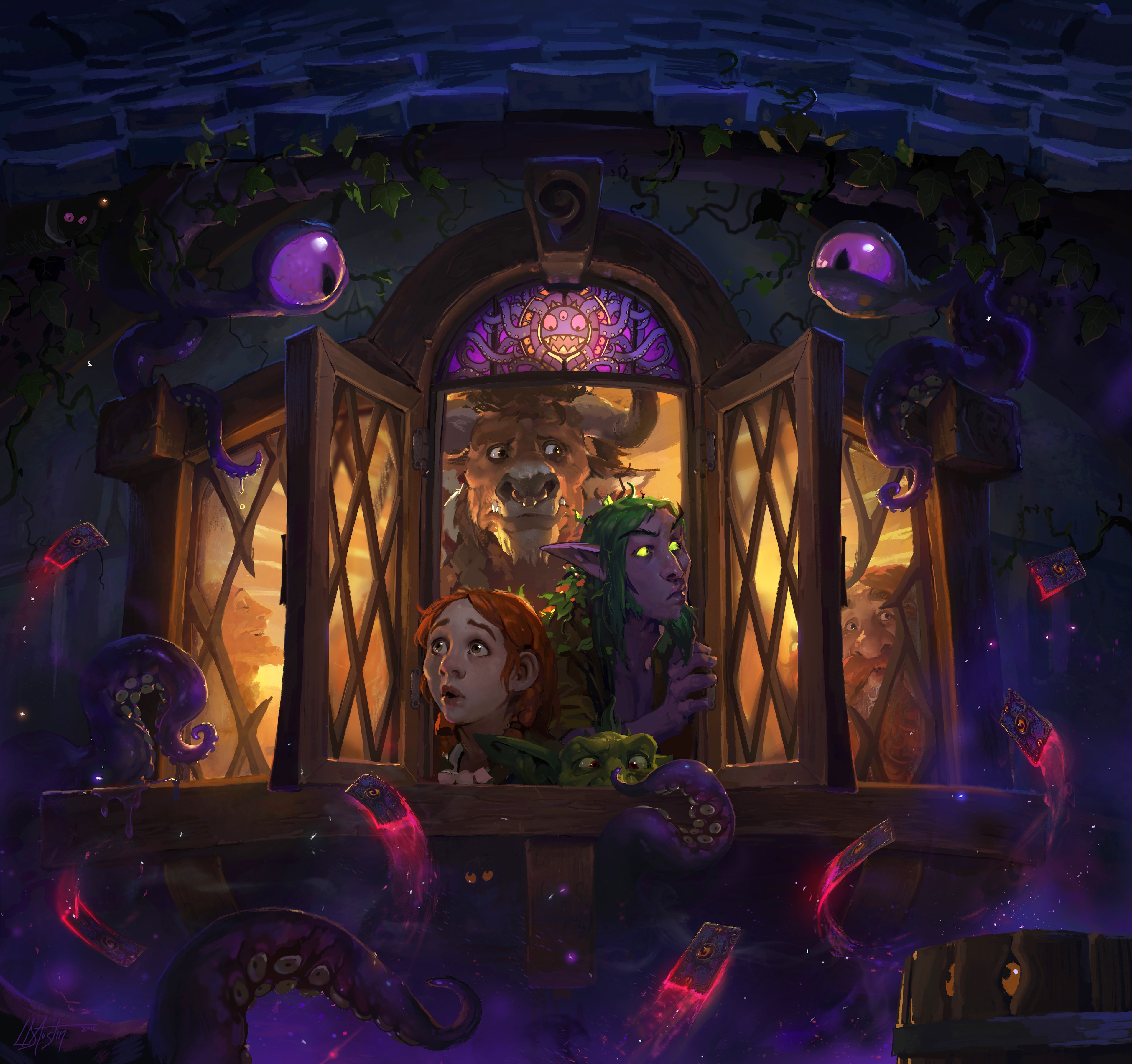
Regardless, I'm at the very least passionate enough to throw out some thoughts; some who-the-whatsits for our upcoming Old Overlords.

While it's true that I'm not known as an absurdly avid Hearthstone player, I have been picking it up more and more as the new set comes in and we start having a shifting meta. I used to be a truly avid Magic: the Gathering player and this new set has me intrigued with it's possibilities.

In other words, to those who do play Magic, I haven't been this intrigued in a card game since Hedron Dredge came onto the scene, which is just a flat out interesting concept for a deck.

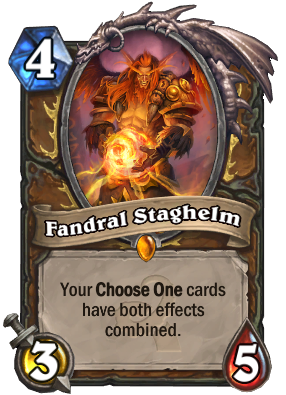
So, what cards have captured my interest? First is Fandral Staghelm.

Hello, I'm a Big Mac Combo.

Fandral Staghelm is fun because he fulfills a common concept found in a lot of CCG: the two-for-one. Now, any Choose One card boasts the idea of a two-for-one already. What's awesome about Fandral is that it makes them better because you don't have to choose. You get to do two potentially great plays.

This was why Jund has become a common staple in Magic: the Gathering. It always followed the concept of a two-for-one. No single card had only one effect in a Jund deck and we might see something like that in Hearthstone if the selection of Choose One cards are actually strong.


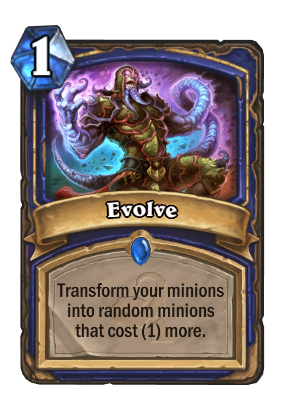
Next card is Evolve.

Weenies no More
Evolve, to me, seems broken. The only argument I'd say against it is that it's random. Still, if you come up with some kind of aggro deck that can pop out a bunch of weenies quickly in the early game and you drop this?

This 1 mana card.

Boy, could they be in for a hurting.

Obviously the randomness is the downside. But we also know that the minions are being transformed into minions that cost 1 more. The potential positives just outweigh the potential negatives here.


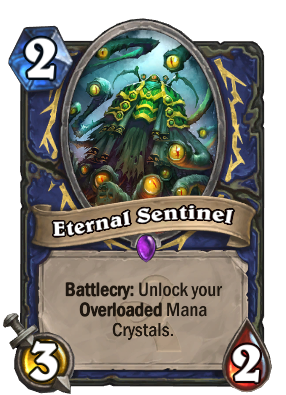
Our third card is the Eternal Sentinel.

I hope you like losing
We can hop back into our Fandral Staghelm concept with this one. This card is a devastating 2-for-1.

First off, a 3/2 critter for 2 mana is inherently, at the very least, decent. I actually think it's GREAT, but for the sake of not getting too excited for something that hasn't seen play yet, let's just say it's decent.

That'd be the case if it were just a 3/2 for 2.

This card also unlocks your overloaded mana crystals.

Oh? The board I just wiped? Your fatty I just zapped? My golem I summoned? Let me get all that mana back for next turn please.

Oh, yeah, and my DECENT 3/2 critter as well.


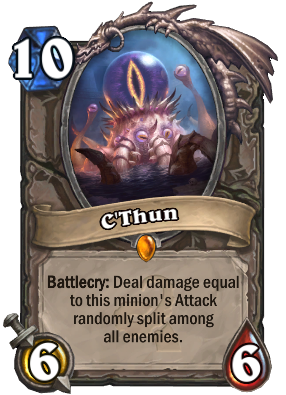
And the last card I look forward to trying: C'Thun.

I'm... So... Old...
C'Thun looks fun for all the right reasons. It's a card design that is based on a character that many people are familiar with due to World of Warcraft.

And even if you never played WoW the flavor of this card has deck builders ready to make this card the late game bomb that it's destined to be.

Think about a Mage control deck that revolves around this card. There's a particular C'Thun supporter that boosts C'Thun's power by 1 every time you play a spell.

Oh, let me wipe your board then kick you later with my massive critter.

The possibilities are endless and this card reeks of potential as far as a late game bomb is concerned.


Needless to say, I'm very excited for this set. I hope to see some of y'all in the random matchups but until then stay inside. The Old Gods are comin.


Monday, April 18, 2016

Why Anyone Would Jump Over Time Pieces is Beyond Me


So. Overwatch comes out soon.

I was given the very fortunate opportunity to play about...

*checks watch*

3 hours of the beta with my sister, who, by the way, was a huge fan of Team Fortress 2.

Our initial reactions have been one of immense excitement.

First off I would like to point out that I was completely sucked into it's intrigue upon watching it's first cinematic trailer. Also, let's be honest. It was actually more or less a short film. Now that's fun. As a filmmaker and critic of both the filmic and gaming spectrum I was hooked. The film wasn't quite Pixar, I knew this in my mind, but it damn sure did a great job of making it feel like Pixar.

The marketing campaign up to this point has followed suit. 2 short films have been released up to the point of this blog post: Recall and Alive. Both are great. Both are immersing me.

And that's the appeal that's really getting me excited not just to play the game of Overwatch, but also what Overwatch is as an entity. It's a game like this has no business having a true immersive universe. A game of this genre calls for good, clean fun with good replayability and updates here and there to keep the game fresh. Where the hell did this sense of story come from?

So I can see some people saying this isn't new... like... at all. It has the gameplay of Team Fortress and the short films are kind of like the ones that Valve also did.

I get that, I really do, but the fact is that plenty of people have done plenty of the same things and what ends up standing out among the sea of clones is execution.

I've felt genuine emotion as I watch Widowmaker jump off the building and aim for her mark in the short film. I shouted an oh no! as my Roadhog was gunned down during an assault mission and leapt for joy as I heard my sister's character: Mercy yell "HEROES NEVER DIE!" It was true. As soon as I heard those words my Roadhog got back up, guns ablaze.

An emotional response like that doesn't just come from intriging world building and being just a fun game. No, I'm giddy just thinking about team comps and strategies. I suppose the feeling I can compare it to was when I signed up to play League of Legends during it's year of inception. I had played games like it before (DotA) but I hadn't played an iteration like this. And I was hooked from that point on.

But this still also feels different.

Blizzard has that kind of attention to detail that makes me feel like there's so much more. I can't wait to see more short films and I can't wait for the open beta. If Blizzard keeps this up, this will truly be a hero that never dies.

Sunday, June 3, 2012

A World of Auteurs


  It's a really good time to be a gamer or someone who appreciates gaming. Regardless of whether you care or not, gaming is up-ing it's stance as a higher art form. It was really only a matter of time. It's reminiscent of the point brought up by Scott McCloud in his wonderful book: Understanding Comics. The problem with comics (video games can take up this position as well) is that it's being judged by the old (because it's perceived as a new art). In other words, those arts that have already established themselves, such as film, literature, music, etc. Comics and gaming are being looked down upon by the other arts. The proof is in the pudding. Ebert, a man who has my immense respect and is also a role-model of mine, argued that video games could never be art. He's commonly known as the premiere film critic of, not only his generation, but the generations that followed, all the way up to today. He's since changed his stance a bit, saying we're just not there yet, and I more so agree with that position. I believe video games are at that point, that it is definitely art, we just haven't found our Citizen Kane yet. In the mean time, we settle for our Battleship Potempkin's and Nosferatu's.

Gaming is undergoing the same scenario presented to film during it's pre- “high art” era, which is convenient for gaming theorists. I feel like Francois Truffaut when he analyzed the works of Alfred Hitchcock. Particular game developers can now be cited as auteurs, evoking a sense of style found uniquely within the soul of one person. Think about prior film experiences. Couldn't one say that Steven Spielberg or Quentin Tarantino have a certain style that they evoke? Same could be said for the likes of people such as Hideo Kojima, Goichi Suda, and Ken Levine. It's one of the reasons I'm excited for Bioshock: Infinite. Yes, the game is being pushed back, something that has yielded more negative results than positive in the grand scheme of things as far as games are concerned.

I'm looking at you Duke Nukem.

But people often forget the hits. Look at the development time of Team Fortress 2. When it was all said and done, Team Fortress 2 is often talked about when it comes to great FPS gaming. Same goes for the original Bioshock, which got pushed back just a little bit during development. Ken Levine had great reasoning, citing that the Big Daddies weren't the Big Daddies that we have come to love, that Rapture's textures needed one more coat of paint, and that Andrew Ryan's golf club didn't quite have the right swing yet. If that's the reasoning behind Bioshock: Infinite being pushed back I'm all for it. I'd rather play the completed game than some half-assed version.

The thing about the Auteur theory is that it is what it is: a theory. It's not some sort of proven thing, but at the same time, it's got some ridiculously strong points going for it. As before mentioned, look at the likes of certain film directors. Wes Anderson clearly has his own cinematic stylings. Same goes for gaming with the people also before mentioned. A common trend in the Suda 51 (Goichi Suda) universe is the bathroom save point. Both Travis and Shinobu use the bathroom (Taking a dump and showering respectively) upon saving the game in No More Heroes. Then there's also Garcia Hotspur who walks up to flying demons who take dumps when he approaches, creating a check/save point.

Really, the point trying to be made here is the correlation of cinema and gaming. Yes, gaming started off primarily as a form of entertainment. It's so much more than that now though. It's working really hard to push forward for that final claim as “high art,” but with it being judged by the other “high arts” it's rather difficult. It's fantastic that the auteur theory has made it's transition into the gaming realm, which is likely to open up the gates to other approaches. Why not the passion for perceiving? It's an idea originally thought of by film theorist Christian Metz. We can even expand on that. There's something inherent when people game. People appreciate music, because they have a beat in their body that can't be expressed otherwise. People appreciate paintings, because it speaks volumes to the eye. Gaming is a way to satisfy a lot of artistic urges. It can be more than just a passion for perceiving, since it doesn't only take note of sight and sound. It currently has touch going for it (although, in that aspect it's not being executed on a profound level i.e. motion controls are gimmicks).

This is both a positive and a negative, because the perceiving arts are often considered the “high arts.” The examples being paintings, cinema, literature, theatre, music, etc. The non-perceiving arts, such as culinary, perfuming, etc. haven't quite been up to snuff as far as great works are concerned. Video games seem to be cornered there because of it's touch approach. At the same time, it's a new experience, not completely understood yet. In the long run, the fact that it entices the sense of touch won't hinder it's argument as “high art.”

So here we are, the transitional phase. Things are coming to light as far as gaming as art is concerned, and we can appreciate it on a profound level, much more so than mindless entertainment.

Monday, April 30, 2012

Appreciated... If That's What They're Going For: Skyrim


My tackling of the subject matter is probably a little late. Skyrim is still being played, but not quite as much. I know some people run off of the occasional visit to the land of Skyrim, but it's not quite the obsessive 20 hour periods that put people into hospitals, because they didn't drink enough water.

True Story.

No, I won't share it with you, that stuff's personal. Wait... Do you think I'm the one who plunged into a chaotic dehydrated state? Nah, it's a friend. Really.

Established Un-reliable Narrator Achievement Unlocked.

I'm not here to talk about the real-world-bad-stuff of Skyrim, I'm here to talk about something I appreciate, if it is indeed what they're going for. That something is the Cave Allegory.

For those of you who don't know what the Cave Allegory is, I'll provide you with a quick summary:

  1. It is an idea created by Plato
  2. It illustrates education
  3. The Story: People in a cave are chained and forced to look at a wall. Behind them is a fire which casts shadows. They see shadows of many things that represent the outside world. Eventually, one person is no longer chained and that person goes outside the cave, seeing real things, not just shadows. They go back into the cave and talk about their outside world experiences, thus sharing knowledge. In turn, the people chained before get free, in order to pursue the new knowledge people before them gained by going outside of the cave.

How does this apply to Skyrim? Well, whichever character you make, you don't really start leveling up until you venture outside of the cave. I mean this literally. In the opening segment, you have to escape underground... through a cave. There's even a sleeping bear to compliment it. It's strangely symbolic and alluding. What exactly does it say when you're leveling up getting out of the cave? Well, it says you don't start learning the truth until you explore things for yourself. It's no surprise, this isn't the first time Bethesda has done this. Look at Fallout 3 for example.

In Fallout 3, we begin the game underground in a vault. Everyone in your original understanding of the world lives there, and most importantly, learns there. When you're finally forced to leave, it's a struggle. It's an attempt to break the shackles. It's even tougher realizing you might not ever come back, especially if you've developed a liking to the people there. Once you break out the doors into the real world you're greeted by a bright light that blinds you for a bit. The world is, all of the sudden, real. This is the truth that some people in the vault had held you back from. As you explore the new world, you gain levels and experience new things. Eventually, you can make your way back to the original vault, which is a story arc I don't want to spoil.

Skyrim does this, but takes a more immersive approach. Think about the typical Skyrim experience: Play the game, stop playing, go out into the real world, talk about it.

We all experience different things outside of the cave. We come back to the cave to share those experiences with friends and family, who then leave the cave in pursuit of the same experience. This is education incarnate, according to Plato.

So, did Bethesda do this on purpose? I can never say for sure. In order to answer that, I'd have to ask the game devs myself. It just feels blatant. If you're playing Skyrim, there's actually a book that you can read that outlines the Cave Allegory.

Shit, if that isn't enough, then I don't know what is.

Still, I know I can't say for sure, but it is almost 100% certainty.

I feel this is a good start in my explorations for rhetorical gaming. After all, games are an art, they convey different messages and teach different things. This is just 1 pair of eyes looking at something I just appreciate. It's something that us gamers can talk about. It's an experience we share. If you have any neat experiences with Skyrim or even the Cave Allegory, I'd love to hear em!